Demo
Modeling Liquid Cooling for a 1 MW Data Center in Roebling
A 1 MW data center does not draw 1 MW. It draws 1.474 megawatts at the utility meter, or 1.352, depending on how much of the cooling system you are willing to actually model.
Tim Lowery
A 1 MW data center does not draw 1 MW. It draws 1.474 megawatts at the utility meter, or 1.352, depending on how much of the cooling system you are willing to actually model.
This video shows both numbers and where the 122 kilowatts between them goes. Roebling builds first-principles models for data centers and AI infrastructure: electrical load, cooling duty, heat rejection, capital and operating cost, resolved before anyone commits to a site. The AI assembles the model. A deterministic equation-oriented solver computes it, so every mass and energy balance closes and every figure opens to the assumption behind it.
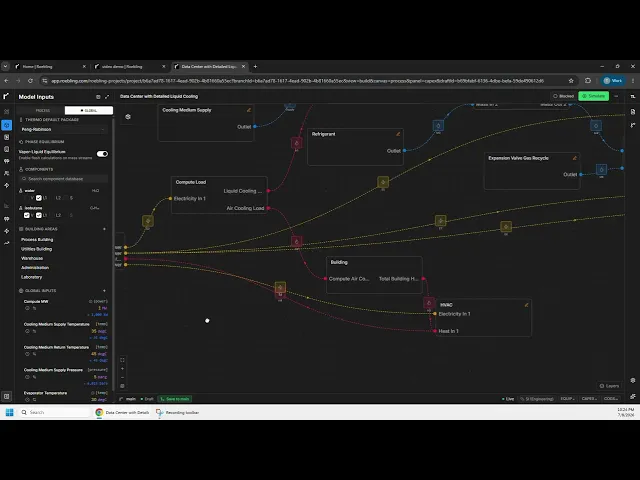
The first model is built by AI from a specification file. It reads the sizing details and lays out the facility: utility power arriving at the distribution unit, a 1 MW compute load that can be adjusted or worked backwards from whatever electricity the site can actually get, and a hybrid cooling system running at a 70% liquid cooling fraction. Siting is an input, indoor or outdoor, and it moves the heat load. So does the building itself, through square footage, indoor and outdoor temperature, radiative and conductive gain, and glazing, all of it resolving into an HVAC load.
The answer comes back at 1.474 MW. The second model takes the cooling side seriously. Instead of treating heat rejection as a duty to be satisfied, it solves the equipment that does the work: a closed loop carrying the cooling medium through a chiller, an evaporator and a circulation pump, and an isobutane refrigerant cycle with a mixer ahead of the compressor, an air-cooled heat exchanger, and an expansion valve holding temperatures and pressures where the evaporator needs them. With pump, compressor and fan power computed rather than assumed, the facility load settles at 1.352 MW. 122 kilowatts is not a rounding error.
It is the difference between a number you carry into a board meeting and one you can defend there. Put the rigor on the subsystem that moves the answer, leave it off the ones that do not, and you arrive at the final investment decision with something worth betting on.
QUESTIONS THIS VIDEO ANSWERS
How much utility power does a 1 MW data center need?
Between 1.352 and 1.474 megawatts in this configuration. Where you land inside that range depends on how much of the cooling system you model rather than approximate, which works out to a facility power ratio of 1.35 to 1.47.
What is a liquid cooling fraction?
The share of server heat carried away by liquid rather than air. This facility runs a hybrid system at 70%, and the fraction is a variable in the model, not a fixed assumption.
Why model the refrigerant loop instead of using a rule of thumb?
Because it moved the answer by 122 kilowatts, roughly 8%. Pump, compressor and fan power all shift with ambient temperature, supply temperature and the choice of working fluid. A ratio conceals that. A model exposes it, and tells you which lever is worth pulling.
Why isobutane?
It is the refrigerant modeled here, R600a. The point is less the fluid than the fact that it is a variable: change it and the compressor duty moves, and the facility load moves with it.
Can a number built this quickly be trusted?
It is computed, not generated. A deterministic equation-oriented solver enforces every mass and energy balance exactly, which means the same inputs return the same answer every time and every equation is open to audit.
Get Started
Schedule a 30-minute strategy session with our team to get access.

We value your privacy
We use cookies to improve site functionality. Some cookies help us understand how visitors use our site.